ENVIRONMENT

Well aware of the need to reconcile economic development with environmental protection, combatting climate change and efficient energy and resource use, Unicaja will consistently promote initiatives and actions aimed at accomplishing said goals.
With respect to the environmental and energy impacts resulting from its operations, Unicaja will act in accordance with the guiding principles set out below as a practical expression of its environmental commitment and to address climate change:
- Continuous improvement of environmental and energy performance through the implementation and maintenance of management systems aligned with recognised international standards, thereby promoting efficient sustainable practices that prevent or mitigate pollution generated by the Institution's operations.
- Environmental impact prevention and control to foster proper management of emissions, waste and consumption, as well as efficient and responsible natural and energy resource use.
- Diligent management of environmental and energy incidents by acting swiftly and responsibly in response to any event that may pose a risk to the environment or energy use, and duly notifying the competent authorities and any affected parties thereof, where necessary.
- Compliance with regulatory requirements and voluntary commitments to ensure fulfilment of any environmental and energy legislation which applies, as well as of any national and international commitments concerning sustainability and the environment voluntarily undertaken by Unicaja.
- Engaging stakeholders and raising their awareness —including the workforce and management— to promote a corporate culture focused on environmental protection, energy efficiency and improving environmental performance.
- Training and capacity building to provide the workforce and management with the necessary know-how in keeping with their level of responsibility to properly implement, monitor and improve environmental and energy efficiency best practices.
- Promoting the circular economy by encouraging the reuse and recycling of materials, the procurement of energy-efficient products and services, the use of the cleanest technologies and eco-design criteria aimed at improving environmental and energy performance.
- External collaboration by working alongside customers, suppliers, public administrations and society at large on initiatives related to environmental protection, energy efficiency and climate change prevention, mitigation and adaptation.
- Integrating environmental and energy criteria into the procurement process by including such criteria in the processes for awarding and monitoring service provision contracts, as well as in relation to suppliers, to promote best practice aligned with the Principles of the United Nations Global Compact.
- Planning, objectives and verification by setting environmental and energy programmes, objectives and targets to ensure availability of necessary resources and conduct periodic internal audits and assessments on this Policy's fulfilment, along with issuing the ensuing monitoring reports.
- Transparency and accountability by making the Policy available to stakeholders and transparently reporting —at a minimum through the corporate sustainability report— about the management, controls and outcomes related to environmental, climate change and energy performance matters.
Grupo Unicaja's Environmental, Energy and Climate Change Policy, the latest version of which was approved by the Board of Directors on 28 May 2026, sets out the basic principles for action on matters related to the environment, energy efficiency and climate change management.
Its aim is to mitigate the environmental impact of Unicaja's operations and actively contribute to protecting the environment, conserving biodiversity and combatting climate change in accordance with the environmental objectives recognised in the European Union Taxonomy (Regulation (EU) 2020/852).
Furthermore, the Policy is aligned with the Ten Principles of the United Nations Global Compact, the 2030 Agenda's Sustainable Development Goals (SDGs) and the Paris Agreement. Grupo Unicaja has endorsed the Responsible Banking Principles and is a signatory of the Carbon Disclosure Project (CDP) initiative.
Unicaja has implemented and certified an Integrated Environmental and Energy Management System in accordance with the ISO 14001 (environmental management) and ISO 50001 (energy management) standards in 30 of the bank's buildings.
The breakdown of the buildings by region and the number of buildings is as follows, reflecting its widespread implementation across the country (covering several regions and different types of establishments within the defined scope):
- Andalusia: 11
- Community of Madrid: 3
- Castilla y León: 5
- Castilla La Mancha: 5
- Principality of Asturias: 2
- Cantabria: 2
- Extremadura: 2
This certification, which was awarded by DNV, certifies that the management system implemented at these sites meets the applicable international requirements and is based on a continuous improvement approach to optimise environmental and energy performance.
This Integrated Management System further strengthens Unicaja's Environmental, Energy and Climate Change Policy by establishing objectives, processes and measures aimed at promoting energy efficiency, reducing environmental impacts and ensuring compliance with legal requirements and other commitments undertaken by the institution.
Through this initiative, Unicaja is cementing its commitment to responsible resource management and sustainable development by systematically integrating environmental and energy criteria into its operations.
Environmental Management System Certificate
Energy Management System Certificate
Unicaja has reduced average Scope 1 and 2 emissions intensity by 90.81% in the 2023-2025 three-year period as compared to the 2022-2024 three-year period.
Unicaja calculates and verifies its corporate carbon footprint across Scopes 1, 2 and 3 with a reduction plan that is aligned with the transition to a low-carbon economy.
The Institution's carbon footprint is duly registered at the Ministry for the Ecological Transition and the Demographic Challenge (MITECO) Registry and it has been awarded the "CALCULO + REDUZCO" (I CALCULATE + REDUCE) seal, which certifies its compliance in matters related to calculating, recording and reducing emissions.
Commitment to decarbonisation
Unicaja takes a comprehensive approach to climate change management, which covers both its direct emissions and those resulting from its operations.
The Institution calculates its emissions in accordance with the international GHG Protocol standard, including the three Scopes, and submits this information to independent external verification, thereby ensuring its reliability, consistency and transparency.
Key indicators and footprint management
Unicaja has a robust system in place that has been verified for calculating and managing its carbon footprint, which is characterised by:
- Full coverage of emissions (Scopes 1, 2 and 3).
- Application of uniform international standards GHG Protocol, or Greenhouse Gas Protocol – Corporate Accounting and Reporting Standard.
- Independent external verification of information.
- Registration at the official MITECO (Ministry for the Ecological Transition and the Demographic Challenge) registry and recognition through the "CALCULO + REDUZCO" (I CALCULATE + REDUCE) seal.
The Institution has an annual emissions record dating back to 2022, which allows their evolution to be analysed on an ongoing and comparable basis over time.
On this basis, an Emission Reduction Plan has been set which includes quantifiable targets aimed at progressively improving its climate performance.
Carbon footprint management is integrated into the institution's corporate strategy and risk management processes, thus strengthening its role in decision-making and adaptation to the energy transition context
Evolution of emissions (base index 2022 = 100
The downward trend detected in the period analysed shows the effectiveness of the emission reduction plan that has been implemented. This contributed to the awarding of the MITECO (Ministry for the Ecological Transition and the Demographic Challenge) "CALCULO + REDUZCO" (I CALCULATE + REDUCE) seal, which recognises not only the quality of calculation but also the accomplishment of properly verified reductions.
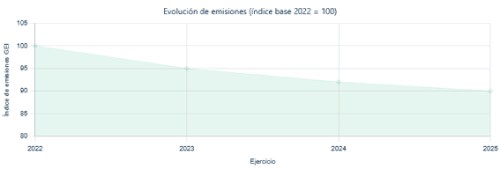
*Significant development of the continuous improvement process and methodological consolidation
Reduction strateg
Unicaja has an Emissions Reduction Plan in place aimed at
- Progressive expansion of the Environmental Management System (ISO 14001) and the Energy Management System (ISO 50001).
- Progressive installation of electric vehicle charging points.
- Progressive replacement of natural gas boilers with more efficient heat pumps.
- Procurement of electricity backed by a Guarantee of Origin (GO). 99% of centres have obtained this certification.
- Development of a Sustainable Mobility Plan.
- Reduction of paper consumption by digitising processes.
Extended approach: financed emissio
Unicaja is making progress in improving its carbon footprint coverage by progressively extending Scope 3 to include emissions associated to its financial activity.
As of the 2024 tax year, Category 15 (financed emissions) was included in the calculation, representing a significant step forward in accurately reflecting of the Institution's climate impact.
This approach allows us to:
- Have a more comprehensive overview of climate impact.
- Align financial activity with the low-carbon economy transition.
- Strengthen the integration of climate criteria into the business strategy.
It also makes it easier to set more ambitious decarbonisation targets that are aligned with the financial sector's best practic.
* For further information on these targets, see the section entit Commitment to the Environment and Sustainability Strate.
Transparencia y reporting
Detailed information on the carbon footprint as well as on its evolution and main indicators is available in the section on the Institution's Sustainability Repo. Sustainability Reports